From a small workshop to a cross-border movement empowering Sudanese youth and communities.
Waey Organization is a Sudanese non-governmental organization, founded and registered in January 2017 under Sudan's Ministry of Culture law for associations and cultural groups, as a voluntary association aimed at raising awareness, promoting and introducing Sudanese cultures, raising awareness and effectiveness in various rights issues, supporting the principle of active citizenship, nurturing creative thinking, enhancing cultural and ethnic diversity, and combating violence, hatred, and harmful traditions.
Waey employs various mechanisms such as launching social and awareness campaigns, establishing and supporting community initiatives, and building the capacity of youth and women to empower them to participate effectively in their communities, civil society organizations, professional and sectoral bodies, and all national institutions, in addition to using artistic, sporting, and creative media means to achieve its goals.
Click to reveal
Active Sudanese citizens, enjoying all their rights, capable of achieving their full developmental potential, and proud of their culture and identity.
Click to reveal
Waey promotes the capacities of Sudanese citizens to build a bright future rooted in human rights and culture. We create spaces for learning, dialogue, and creativity — fostering teamwork and partnerships to drive meaningful change.
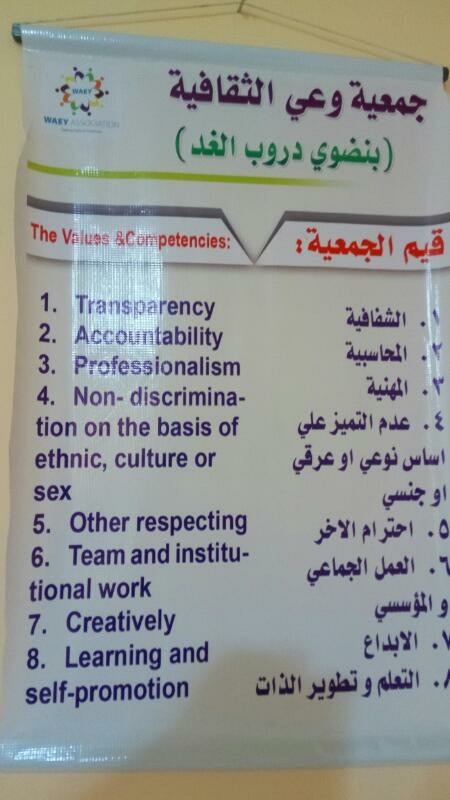
Waey Organization, in its institutional development program, emphasizes the integration of all these values in its constitution, policies, procedures, and code of conduct, to be binding on all its staff, volunteers, and implementing partners.
No discrimination based on race, culture, or gender.
Promoting the spirit of volunteer work and belonging to humanitarian action.
Full commitment to work rules and institutional principles.
Commitment to quality and professional standards in all activities.
Working to establish transparency and institutional accountability rules and systems.
Encouraging exchange of experiences, constructive ideas, learning, self-promotion, and supporting creativity.
Adhering to accountability rules and mechanisms in a way that positively affects the target group.
Commitment to child and youth protection policies in all our programs.
Ensuring protection and integrating a gender perspective into all our activities.
A brief look at how Waey Organization evolved through pivotal moments in Sudan's recent history.
Born from a 2016 workshop, Waey laid its foundation in grassroots civic education. Despite the challenges of the civic space, we focused on building local youth capacities and spreading fundamental human rights awareness.
The democratic transition opened new horizons. Waey rapidly expanded its scope, leading nationwide peacebuilding dialogues, anti-corruption campaigns, and openly advocating for institutional reforms alongside youth movements.
Adapting to profound crisis, Waey extended its arms across borders. We now actively operate to combat hate speech fueling the conflict, while concurrently providing vital support frameworks for Sudanese refugees in Uganda and Egypt.
A look at how Waey's strategic vision evolved from its founding
Upon its establishment, Waey defined three strategic tracks to guide its work:
Waey designed its first four-year strategy with the overarching theme of promoting democratic transition and supporting Sudanese civil society. The following strategic tracks were identified:
To achieve strategic objectives and sustain impact, Waey adopted the following approaches after providing comprehensive training to its staff, volunteers, and implementing partners:
In designing, implementing, monitoring, and evaluating all programs, Waey takes the following cross-cutting issues into account:
Waey updated its strategy to align with the repercussions of the April 2023 war in Sudan. After relocating its headquarters to Uganda, the organization revised its goals and tracks during a strategy meeting concluded on September 1, 2024, establishing the following strategic priorities: